Welcome to TCBD

The high-density genetic maps of rubber、cassava、pineapple and mango were constructed in this database. Combined with the phenotypic data of multiple traits, the main QTL loci of each trait were identified. It is helpful to optimize the characters and improve the yield of tropical crops by molecular breeding.

Epigenetic map and genetic map basis of complex traits in cassava population

A cold-tolerant, high-quality, and robust supply of cassava is urgently needed. Here, we detected 77 much candidate QTLsepi for cold stress and 103 much candidate QTLsepi for storage root quality and yield in 186 cassava population
This may accounted for a significant amount of the variation in the key traits controlling cold tolerance and the high quality and yield of cassava.

An ultra-high density map allowed for mapping QTL and candidate genes controlling dry latex yield in rubber tree

Here, we identified 571,267 SNPs and 134,184 indels, and constructed the first ultra-high density genetic linkage map in rubber tree population.
Accurate QTL mapping will be enhance genetic studies that can be applied in rubber tree breeding programs.

An integrated genetic map of pineapple (Ananas comosus (L.) Merr.)

The inclusion of multiple new markers, in particular 41 sequence specifific markers, resulted in drastically improved version of a previously published F1-based genetic map of pineapple (Ananas comosus).
The present integrated genetic map is expected to be a helpful tool in genomic studies on pineapple and other Bromeliaceae genera and species.

Genetic Map of Mango: A Tool for Mango Breeding

The composite 2412-cM map integrates 10 biparental maps (comprising 3480 meioses) and organizes 22,403 genetic markers on 18 chromosomes, in agreement with the observed karyotype.
The chromosome-anchored genome sequence will be useful for breeding improvement by assisting in the rapididentification of markers linked to important traits, and in providing a framework for genomic selectio-enhanced breeding of this important crop.

A saturated genetic linkage map of rubber tree (Hevea spp.) based on RFLP, AFLP, microsatellite, and isozyme markers

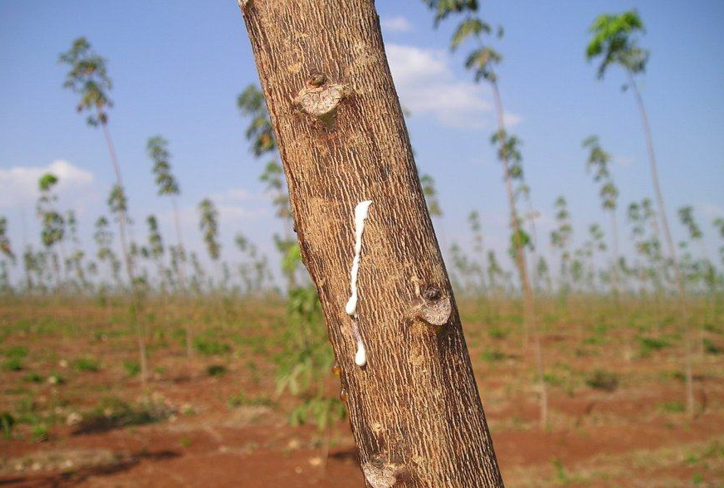
The first genetic map for Hevea spp. (2n=36) is presented here. It is based on a F1 progeny of 106 individuals allowing the construction of a female, a male, and a synthetic map according to the pseudo-testcross strategy.
Comparison of the distance between loci in the parental maps revealed significantly less meiotic recombination in the interspecific hybrid male parent than in the female parent.

Genetic Determinism of Sensitivity to Corynespora cassiicola Exudatesin Rubber Tree (Hevea brasiliensis)

An indirect phenotyping method was developed in order to estimate the susceptibility of rubber tree clonal varieties to Corynespora Leaf Fall (CLF) disease caused by the ascomycete Corynespora cassiicola.
The CCP filtrate clearly contrasted with all other filtrates. The toxicity test based on Electrolyte Leakage Measurement offers the opportunity to assess the sensitivity of rubber genotypes to C. cassiicola exudates or purified effectors for genetic investigations and early selection, without risk of spreading the fungus in plantations.

An EST-derived SNP and SSR genetic linkage map of cassava (Manihot esculenta Crantz)

Here, a genome-wide SNP based genetic map of cassava anchored in SSRs is presented.
This more saturated genetic linkage map of cassava that combines SSR and SNP markers should fifind several applications in the improvement of cassava including aligning scaffolds of the cassava genome sequence, genetic analyses of important agro-morphological traits, studying the linkage disequilibrium landscape and comparative genomics.

High-Resolution Linkage Map and Chromosome-Scale Genome Assembly for Cassava (Manihot esculenta Crantz) from 10 Populations

A microsatellite-based linkage map of cassava was drawn using SSR markers and a F2 population consisting of 268 individuals.
SSR markers reduce the time and cost of mapping quantitative trait loci (QTL) controlling traits of agronomic interest, and are of potential use for marker-assisted selection (MAS).

Genetic analysis and QTL mapping for multiple biotic stress resistance in cassava

A high-density linkage map was constructed with 2,125 SNP markers using a genotyping-by-sequencing approach. For phenotyping, clonal evaluation trials were conducted with 120 F1 individuals for two consecutive field seasons using an alpha-lattice design at Chambezi and Naliendele, Tanzania.
Markers underlying these QTL may be used to increase efficiencies in cassava breeding programs.

KASPar SNP genetic map of cassava for QTL discovery of productivity traits in moderate drought stress environment in Africa

To aid molecular genetic analysis of traits, a linkage map covering 1582.8 cM with an average resolution of 3.69 cM was constructed using 505 polymorphic SNP markers distributed over 21 linkage groups.
The availability of KASPar SNPs are anticipated to improve the implementation of MB for the development of high performing drought tolerant cassava varieties in Africa.

About us

The "genome and big data breeding" team of Sanya Nanfan Research Institute of Hainan University is mainly engaged in genome sequencing, transcription level, high-throughput technology development, big data breeding technology and methods. Develop a multi omics platform to provide a big data analysis system such as complex genome and methylation at the chromosome level. Published the world's first fine Genome Atlas of cassava, passion fruit and elephant grass. Complete the genome assembly of potato autotetraploid haplotype and Magnoliaceae haplotype against extremely complex genomes. Two generation ultra-low-cost genotyping technology and epigenetic analysis technology were originally developed, and low-cost hyper SEQ sequencing technology was widely used. It has been successfully used in about 50 species and more than 10000 samples. It has been granted 4 national invention patents and 3 international invention patents. Nuclear acids research, the innovation, molecular ecology resources, horticulture research, biotechnological biofuels, nature communications and other SCI journals have been published, with 26 first or corresponding authors and cumulative impact factors exceeding 100. Director of two national key research and development projects, presided over and participated in more than 10 scientific research projects such as National Natural Science Foundation and regional key funds.

  Contact us

Genome and Big Data Breeding Center in Sanya Nanfan Research Institute of Hainan University

  Gannong Avenue, Yazhou District, Sanya City, Hainan Province

  Email:zqiangx@gmail.com

  Phone:13637691088

Copyright © 2022 Genomics and Breeding Big Data Center in Hainan University | Designed by Xia Lab